
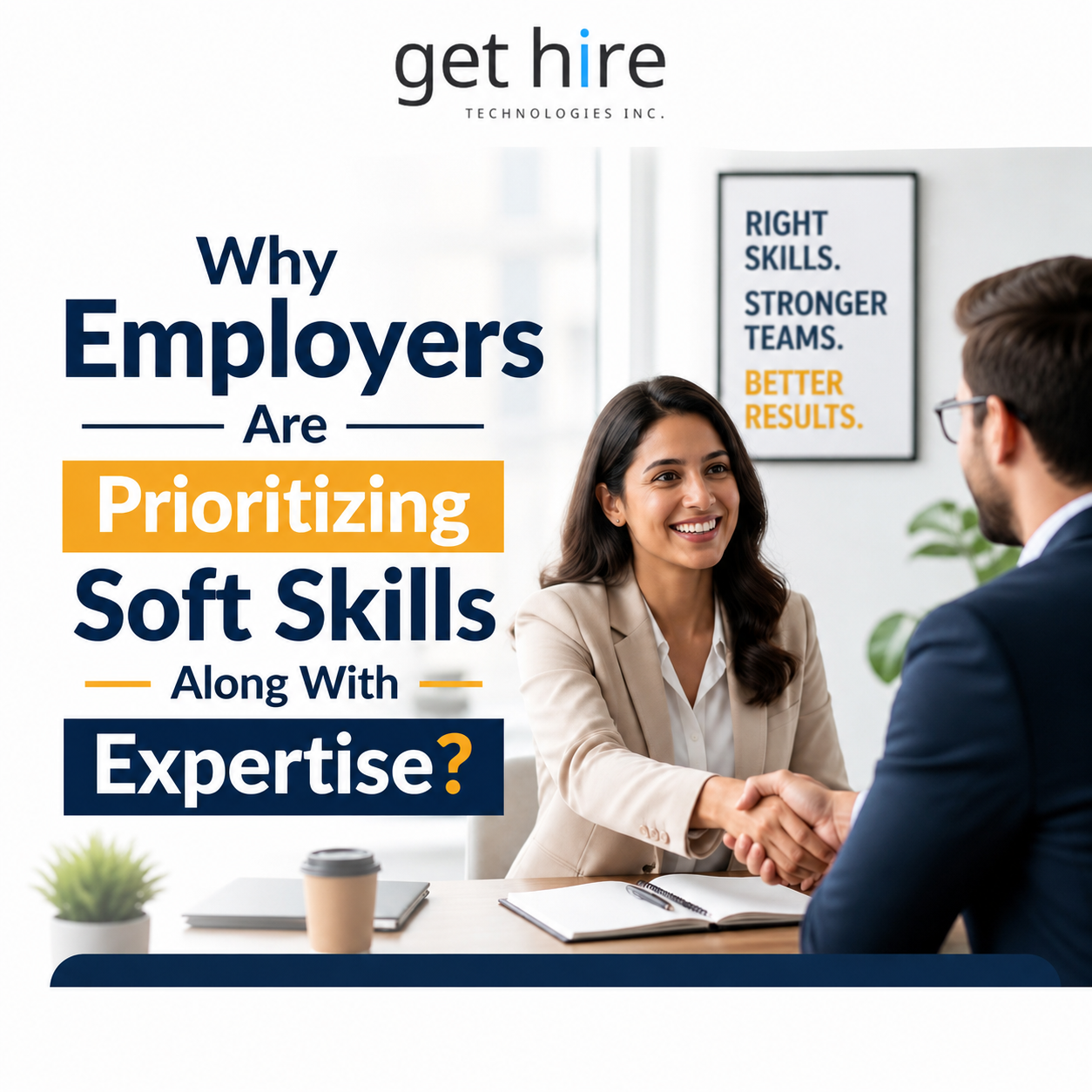
Employers place as much importance on soft skills as on technical skills. Employers are emphasizing as much on soft skills as they are on technical skills.
The days of “what you know” being the definitive answer to employment opportunities are gone. Be able to write code? Are you familiar with data structures? Did you get qualified in the appropriate tools? If so, you’ve been hired! The golden ticket was technical skill and everything else was a bonus.
However, there’s been a big change in the last few years and anyone who has done their job correctly will tell you that the rules of the game have changed. Getting into an interview with a fantastic technical resume is no longer sufficient today. Employers are looking at your thinking ability, communication skills, response to stress and your ability to work with other human beings. Soft skills are no longer in the fine print of a job description, but in the spotlight.
At Get Hire Technologies, best staffing agency in USA, we are right in the thick of thousands of hiring conversations annually – and it’s clear that there’s a pattern. Let’s dive into the reasons behind this change, look at the implications for job seekers, and see how employers are adapting their views of talent.
The Cracks That Technical Skills Alone Can’t Fix
Imagine that a software developer writes perfect code and doesn’t accept input on code reviews. A financial analyst creates great reports and gives them away without losing the room to non-financial people. A project manager is familiar with all the methodologies described in the book, but seems to have a problem keeping the team motivated during a crunch of deadlines.
These are not uncommon occurrences. They can only be regarded as happenings of the normal office.
Knowing the right people opens the door. It shows that you can work. However, once you’ve arrived, your capacity to fit with a team, learn new things, control your feelings, and communicate clearly makes all the difference — and so does the value you add.
Expensive trial and error has been the route organisations have so gradually been forced to follow. An awful hider isn’t only a burden; it costs cash, disturbs team dynamics, and occasionally can even delay projects by months. And it’s not always that someone lacked technical knowledge, as these expensive hiring pitfalls are more often than not. They are because that person had some kind of challenge with working together, with communication, or with developing.
So, what in the heck is a soft skill anyway?
To be clear, it is important to state exactly what is meant before proceeding. Soft skills are not personality or “charm. They are a unique collection of social and mental skills that influence an individual’s performance in their workplace.
The following are some of the most desirable soft skills sought by employers these days:
- Communication – clear and effective communication, both in a presentation and a report, or in an email or with a colleague.
- Emotional Intelligence (EQ) – Understanding and managing one’s own emotions as well as understanding and responding to others’ emotions.
- Adaptability — Ability to adjust to changes in priorities, technology, or situations when things go wrong.
- Critical Thinking — The ability to think critically about the information, challenge underlying thinking, and make sound decisions.
- Working together — collaboratively: Using different abilities and strengths to achieve a common objective.
- Problem-Solving — The natural tendency to solve problems before they are given to them.
- Time Management — How to prioritize, focus and not be micromanaged.
- Leadership – And this does not involve the role of a manager. It’s about self-initiative, taking responsibility, and leading others when necessary.
No one would include any of these in a CV as they are not related to the certificate. However, they all receive active consideration during the hiring process — in many cases, without the candidates even being aware of it.
Why The Shift Happened Now
The emphasis on soft skills is not just a fad. It has been a long time in the planning stages, aided by a couple of key factors.
Collaborative Workplaces: A New Rise
Most work is not solitary and is seldom completed by a single individual. The cross-functional nature of collaboration is also present in the most technical roles, such as software development, Data Science and Cyber Security. Developers collaborate with product designers and marketing. Data scientists are required to communicate results to business decision makers who aren’t ‘interested’ in statistical methods. Non-technical employees need to be trained on cybersecurity.
Communicating and collaborating are not something you do; it’s the job if you’re working in a cross-departmental team with people who have different backgrounds and sometimes different time zones.
Automation has altered the human role
Less predictable than five years ago: AI and automation are taking over repetitive rule-based tasks. What’s left for us to do are the things that machines can’t do—make judgment calls, deal with ethics, solve problems creatively, make decisions with empathy, and form relationships.
It’s not a trivial matter. It is a transformation of the requirements of employers’ manpower. If the routine technical work is something the machine can do, the human team member must have something else: the ability to work in an ambiguous situation, to have social intelligence and personal insight that the machine cannot.
Remote And Hybrid Work Raised The Stakes
With the rise of remote and hybrid work, the world has come to the realization of the extent to which the culture of the workplace relied on proximity. Communication Skills are crucial survival skills when the option to stroll and speak to a co-worker and read his body language is taken away.
Telematic employment also requires a strong sense of self-motivation, self-discipline and trust. Presence is no longer the management mode that can be used by employers; now, it is about outcomes. The successful people there have great time management skills, they communicate proactively, they’re emotionally resilient, and they’re able to work without losing momentum on their own.
Customer-Facing Expectations Evolved
There’s been a rise in customer expectations everywhere. People expect to be heard, understood and/or treated with respect, regardless of the industry you’re in. All staff involved in any way with customers must have the sensitivity and ability to communicate with them in a human manner, not a businesslike manner.
Actual changes that employers are making
Understanding the importance of soft skills is a different thing. The other is changing your hiring practices for them. Progressive employers are doing what? So what are progressive employers doing to get past the resume that’s all about keywords?
Behavioural Interviews are now commonplace. Questions such as “Tell me about a time you had to deal with a conflict within your team” or “Describe a time when you were forced to adapt quickly to a change” are used to shed light on what anyone actually does in the real world, rather than what they say it is.
Work Simulation Exercises are becoming more popular, especially at senior levels. They’re presented with a realistic situation — a challenging client, a conflict with team members, an unexpected project requirement, etc. — and asked to rehearse what they would do about it.
Culture Fit Conversations are now more formalized assessments of values alignment and working style, team building. Rather than asking more superficial questions about how candidates like to be evaluated, hiring managers are inquiring about how they handle conflict and what sort of work environment enables them to think best.
More and more large companies are using Psychometric And EQ Assessments to create a holistic profile of the person they are interviewing.
We believe that the only way to hire the right person is to assess both technical skills and interpersonal capability — and at Get Hire Technologies, best staffing agency in USA, we work with organisations to create a hiring process that focuses on both.
Misunderstanding that prevents candidates
How many soft skills are being assessed is something that still needs to be communicated clearly to many job seekers. They build up their portfolio, practice technical questions, look into the company’s products — and then go into the interview, where they learn things about how the products work, not what they know about them.
There is also a myth that soft skills are inborn: you have them or you don’t. This is not the case. Communication is a skill that is learned. Emotional regulation is not innate. Emotional regulation is not something that’s just something that happens. With the proper experiences and presence of mind, leadership instincts can be developed. These are skills that can be learned, coached, and are not inherently part of the job.
Generally speaking, for people looking for a job, I have a good idea: If you have a technical accomplishment on your CV, consider what soft skill was essential to that accomplishment. Were you in charge of the project? Are you able to solve a conflict in a group? Have you conveyed a complicated result to a non-technical audience? Make those stories visible as hiring managers are looking for them.
The winning balance that is actually a balance
This is not to be interpreted as a statement that technical skills are no longer relevant. They absolutely do. Technical skills are essential in a competitive job market. It remains that you must be extremely familiar with your craft and be able to produce results.
It’s all about the combination. These are the technologists, the emotional people, the builders, the explainers, the doers and the sharers who are hired, promoted and trusted with the important work.
No longer are employers deciding whether they want to hire a smart girl or a good girl. They are holding out for both.
What does this mean for the future of hiring? What does this imply for the future of hiring?
The value of humans will grow as work becomes more automated, more global and more complex. Technical skills will be more specialised and will soon be out of date. Learning, adapting, communicating and connecting skills will be consistently useful.
For employers, it’s the time to invest in deeper hiring practices than credentials. It is about developing an understanding of and scoring soft skills in a systematic way that is comparable to technical assessments. It means fostering a culture in the workplace that truly promotes collaboration, development and openness — and not just outputs.
For those looking to advance in their jobs, this is not a question. Both are part of your plan to advance in your career. Keep up to date with technical skills. But also work on how you show up to others around you. How good a listener are you? How well do you communicate generally? What is your approach to feedback?
Those answers are more important than ever.
Final Thought
The greatest professional is one who can perform and lift up the man or woman with him. It’s what employers want and great teams are made of.
Get Hire Technologies, best staffing agency in USA, believes that hiring should not be a shot in the dark. We know that having an understanding of a position’s technical needs and the human needs that make a person effective in that position is what helps companies find a person who changes the dynamics of the role, not just fills it.
The future of work is for critical thinkers, team players, and lifelong learners. Be one of them!