Let’s be honest. If you are still treating work like a temporary perk, a work-from-home survival tactic, or just working from home in your sweatpants, you are already behind.
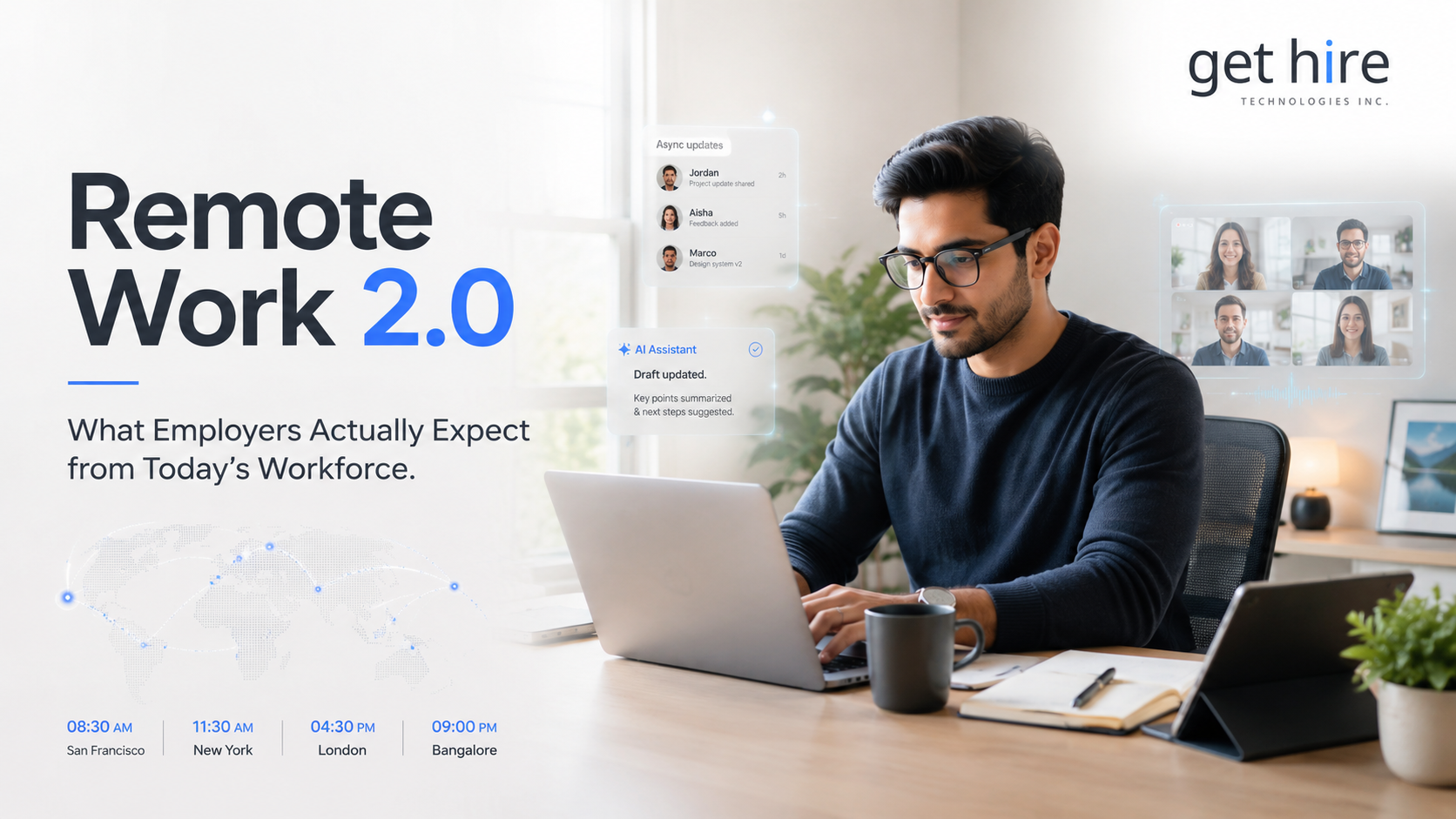
Welcome to mid-2026. The dust has long settled on the remote work experiment. We aren’t just figuring out how to make Zoom calls without talking over each other. We’ve moved past the hybrid experiments of the early 2020s. What we have now is Remote Work 2.0. It’s intentional. It’s highly tech-enabled. Frankly, it’s a completely different beast.
For employers, the initial panic of “how do I manage people I can’t see?” has given way to a more nuanced question. How do I build a performing connected culture in a borderless world?
The rules of the game have changed. The expectations have shifted, too. So what do employers actually want from the workforce today? Grab a coffee. Let’s break down the reality of remote work.
The Death of the “Always-On” Hustle (Outcomes Over Hours)
Remember when remote work first hit?. Managers were secretly installing software to track employees’ mouse movements? Yeah, we’re glad that’s in the rearview mirror.
In Remote Work 2.0, the micromanagement hangover is over. Employers have realized that tracking hours is a metric for actual productivity. Today, the expectation is entirely outcome-based.
Companies don’t care if you do your work at 6:00 AM or 10:00 PM. They don’t care if you take a two-hour break in the middle of the day to walk your dog or pick up your kids. What they care about is whether you hit your targets. Whether you delivered a high-quality project. Whether you moved the needle forward.
You need to be fiercely self-managed. Employers expect you to understand the core goals of your role. Figure out an efficient way to achieve them. If you need to work in bursts. If you need uninterrupted focus time, block it out on your calendar. Just make sure the results speak for themselves.
Asynchronous Communication is the New Superpower
Here is a truth. Nobody wants to be in another meeting that could have been an email. Actually, in 2026, it should be: “nobody wants to be in a meeting that could have been a video update or a well-structured Slack thread.”
Zoom fatigue is real. Smart companies are ruthlessly protecting their employees’ time. The modern employer expects their workforce to be masters of communication. This means writing. Providing context without being asked. Understanding that not every question requires a real-time response.
Your keyboard is your handshake. You need to be able to articulate ideas in writing. When you do get on a video call, it should be for problem-solving. For brainstorming. For building relationships—not for giving status updates. Learn to use async tools. Record quick Loom-style videos to explain a concept. Respect your colleagues’ time zones by not expecting replies.
AI Fluency and Tech Adaptability
Let’s talk about the elephant in the room. Artificial Intelligence. Years ago, AI was a novelty. Today, it’s the co-pilot sitting next to you.
Employers in 2026 aren’t necessarily expecting every marketing manager or HR specialist to know how to code. They do expect a baseline level of tech fluency. Specifically, when it comes to leveraging AI to work. If you are still doing data entry, writing first drafts of basic reports from scratch or spending hours summarizing long documents, you are working too hard.
Show that you can adapt to tools quickly. Employers want problem-solvers who use technology to eliminate tasks. So they can focus on level, strategic and creative work. Be the person who figures out how to automate a process. Then teaches the rest of the team how to use it. Adaptability is the currency in the modern workforce.
Intentional Culture Builders
Here is the part about remote work. The “watercooler moments” don’t happen by accident anymore. You can’t just bump into a colleague in the hallway. Chat about the weekend.
Because of this, employers are placing a premium on employees who are intentional about culture. They want team members who actively work to build bridges across the divide. If everyone just logs on, does their work and logs off, the company culture will die.
You have to be proactive about connection. This doesn’t mean you need to be the voice in every virtual meeting. It means taking five minutes at the start of a call to ask how someone’s day is going. It means jumping into a coffee chat” channel to share a funny article. It means showing up to the virtual trivia night. Employers expect you to be a participant in the culture, not a passenger.
Emotional Intelligence and Boundary Management
This one might surprise you. You’d think employers just want people who work 24/7. In Remote Work 2.0, smart employers know that burnout is a massive productivity killer. A burned-out employee makes mistakes. Lacks creativity.. Eventually quits.
Because the physical boundary between “home” and “office” is gone, the mental boundaries have to be stronger than ever. Employers actually expect you to guard your off-hours. They want you to log off at a time. Take your PTO. Prioritize your health.
Give people the benefit of the doubt in text-based communication. Assume intent. Check in on your colleagues if they seem quiet. Most importantly, model good boundary-setting behavior. When you log off for the day, actually log off. Employers respect professionals who know how to recharge because those are the people who bring themselves to work the next day.
Global Mindset and Inclusivity
Remote Work 2.0 has blown the talent pool open. Your team might be spread across New York, London, Bangalore and São Paulo. This is a thing, but it requires a shift in perspective.
Employers expect their workforce to have a mindset. This means being culturally aware. Inclusive. Respectful of working styles and holidays. It means scheduling that meeting at a time that doesn’t force your colleague in Australia to join at 2:00 AM.
Be curious and empathetic. Take the time to understand the nuances of your global teammates. Celebrate perspectives because a diverse, distributed team is only as strong as its ability to make everyone feel like they belong.
The Bottom Line: It’s About Trust and Impact
If you look closely at all these expectations, a common theme emerges. Remote Work 2.0 isn’t about working; it’s about working with more intention.
Employers are no longer looking for people who just punch a clock. They are looking for tech-savvy, emotionally intelligent professionals. Professionals who can communicate clearly. Deliver results. Help build a culture from anywhere in the world.
It’s a bar, absolutely. It’s also a much more rewarding way to work. It offers flexibility. Trusts you as an adult. Focuses on the value you bring rather than the hours you sit in a chair.
How Get Hire Technologies Can Help You Navigate the Shift
Whether you are an employer trying to figure out how to hire and manage this breed of remote talent or a candidate looking to position yourself for the best remote roles in 2026, the transition can feel overwhelming. The rules have changed. You need a partner who understands the new playbook.
That’s where Get Hire Technologies, best staffing agency in USA, comes in.
We don’t just match resumes to job descriptions. We understand the nuances of Remote Work 2.0. For employers, we help you define outcome-based roles. Build async workflows. Source global talent at the source tier that fits your unique culture. For job seekers, we help you highlight your adaptability, tech fluency and self-management skills to stand out to thinking companies.
The future of work isn’t just remote; it’s refined. It’s centric, tech-enabled and entirely focused on impact.
Ready to thrive in Remote Work 2.0? Let’s build your future together. Visit Get Hire Technologies, best staffing agency in USA today. Let’s find the perfect fit for your evolving workforce.