
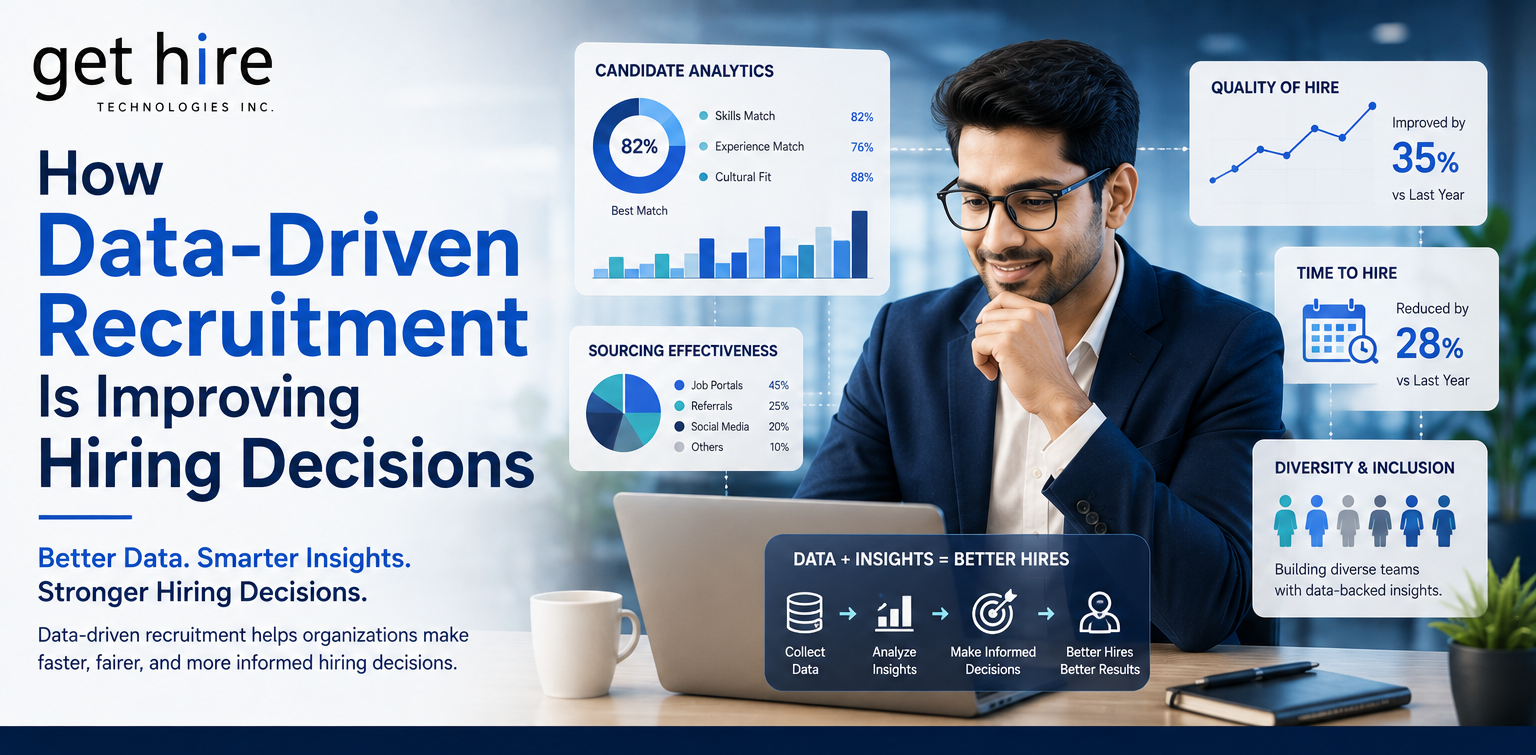


Gone is the guesswork, replaced by Data-Driven Recruiting for Employers that can make quicker, fairer and more accurate decisions. For hiring firms, it translates to a recruitment process that increasingly demands skills, clarity, and quantifiable fit.
According to Get Hire Technologies, best staffing agency in USA, data-driven recruitment relies on data from resumes, assessments, source tracking, interview scores and hiring outcomes to inform hiring decisions. Recruiters don’t just depend on their gut instincts and conduct comparisons of candidates with the same metrics, including skills, experience, time-to-hire and quality of hire. This is increasingly being used to improve the quality of hires, hiring efficiency and retention.
Hiring may be affected by bias, lack of information and/or inconsistent interviewing practices. Data helps recruiters have a better idea of which candidates have a strong potential for success, retention and early production. It can also help teams identify where candidates get stuck along the way, enhancing the overall experience and minimizing wasted effort. That implies that hiring is based on patterns, not assumptions.
Workers’ benefits for those seeking employment
This transition may be a positive one for those looking for employment. Structured data makes it easier for companies to score on relevant skills and performance indicators, providing more space for qualified individuals who may have gone through a different path. It also helps to clarify the points to consider in terms of job qualifications, in most instances giving applicants an idea of what employers are looking for. With good analytics, recruiters will not miss out on good candidates because they don’t conform to the traditional profile.
Better Hiring Outcomes
Recruitment analytics can help employers determine which sources are best for recruiting, such as referrals, job boards, campus hiring, etc., so they can focus on the ones that will yield better candidates. It can also help to facilitate faster screening and skill matches for roles. According to some reports, organizations that use analytics experience increased hiring quality, efficiency and fairness. Data is not only accelerating teams, but also facilitating them to hire smarter, in other words.
What Employers Track
Typical metrics that teams are tracking include a variety of practical ones. These are typically time-to-fill, cost-per-hire, offer acceptance rate, source effectiveness, candidate drop-off and quality of hire. Predictive analytics is also used by more advanced teams to predict turnover rates and skill deficits that will determine their future hiring needs. Combined, those numbers can help recruiters make more informed decisions about their job descriptions, steps and sourcing strategies.
Job Seekers’ Checklist
Knowledge of data and its impact on the hiring process can be helpful for job seekers. Many companies utilize a digital screening and analytics process at the beginning of the hiring process, so a strong resume should be clear, keyword-oriented and highlight measurable outcomes. It also facilitates the development of evidence of impact through projects, certifications, portfolio samples or in quantitative terms.
The Bigger Shift
It’s not so much a technological change as it is a cultural change. The culture of recruitment is shifting from ‘who seems right‘ to ‘who proves fit,’ and that helps to be more accountable about recruitment. This translates into the fact that for job seekers, preparation is a key ingredient—more than polish—when it comes to finding a job. Today, the job talk is more focused on the applications, their relevance, and what has happened in the applicant’s work.
Final Thoughts
This data-driven recruiting is making the hiring process more objective, efficient and insightful. It’s great news for anyone looking for employment, as it gives them the incentive to prepare, adapt and do the job according to Get Hire Technologies, best staffing agency in USA. With more and more businesses turning to analytics, candidates who understand how a business recruits will have an edge.
Frequently Asked Questions (FAQs)
What is data-driven recruitment?
Data-driven recruitment is the process of using hiring data (including assessments, source performance, interview scores and hiring outcomes) to help guide your recruitment decisions.
What are the benefits for job seekers of data-driven recruitment?
It makes hiring more skills-based and transparent, helping to increase fairness for candidates who possess the right skills and experience.
What data do recruiters use for hiring?
Typical metrics tracked by recruiters include time-to-hire, cost-per-hire, source quality, candidate drop-off, offer acceptance rate and quality of hire.
How effective is data-driven recruitment in eliminating bias?
It has the potential to decrease bias if companies use systematic criteria for hiring and systematic measurement of the job, as decisions are based on evidence rather than first impressions.
Why is data-driven recruitment important for Get Hire Technologies?
It aids in creating a more reliable hiring process for the job seeker and employer for the better, empowers recruiters to get better matches and improves the hiring process’s efficiency.