
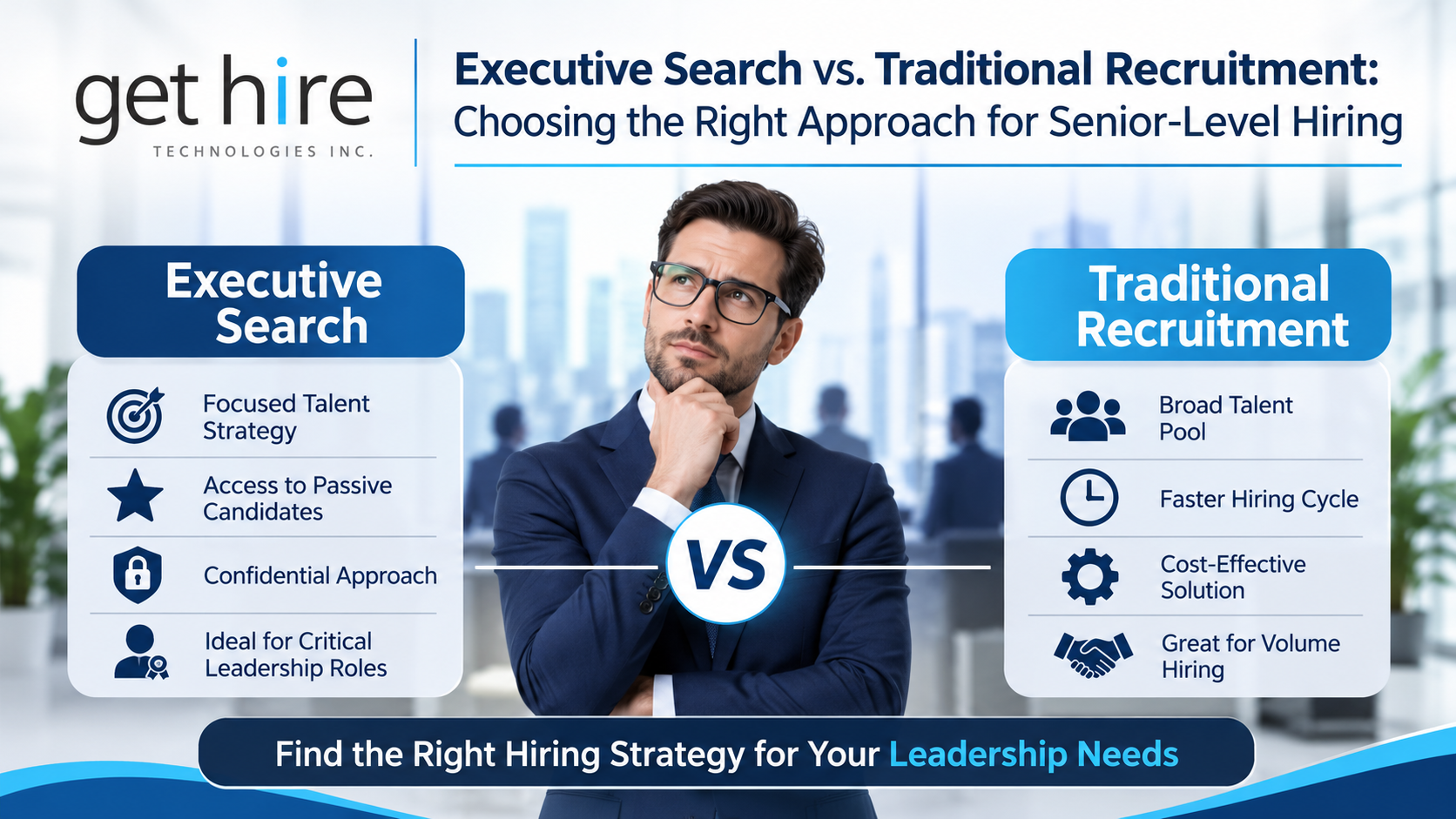


The recruitment process for a senior management role is unique and not just a regular recruitment process. While hiring a leader, you are potentially changing strategy and culture, leading to high budgets and affecting the long-term direction of a company. That is why it’s important for U.S. employers to carefully consider their hiring approach.
Certain positions are suited to a traditional recruitment approach, particularly in a fertile candidate market. Typically the preferred choice for high-level, niche or confidential positions requiring someone that may not be actively seeking employment. It’s important to understand the difference, as it can help employers select the one most appropriate for their business.
What Traditional Recruitment looks like
Traditional Recruitment is a very broad process of recruitment and hiring at various levels. Usually works with job posting, applicant tracking systems, applicant databases, referrals and professional networks.
It can be used when a job position is clearly defined, applicants are plenty and the time to fill the position is not too long. It is regularly applied in entry-level, middle and some management-level jobs.
Examples of traditional recruitment processes include:
- Posting the job on career and employment websites and forums.
- Interviewing assessors.
- Screening candidates by phone and video interviews.
- Leading job interviews with the Head of Hiring.
- Reference checks and offers of employment.
- Communication & Onboarding Management for candidates.
In some technology, administrative and operational positions, this process can yield significant results within a short timeframe.
What is Executive Search
Executive search is a process dedicated to senior leadership positions that results in a concentrated effort supported by research. Often applied for C-Suite and vice president, senior director and board positions.
Executive search, as opposed to the conventional recruitment process, isn’t merely an active embodiment of those who are applying. Proficient search firms follow a process of finding and reaching out to potential leaders in similar firms and evaluating them against a set definition of what a leader looks like.
Executive search is not just a mere senior mode of recruitment. It is a prescribed process designed to make leadership decisions that are powerful.
Retained executive search will involve: Role definition, market mapping, confidential outreach, candidate assessment, shortlist development, offer negotiation and onboarding support.
Differences between the Two Models
| Factor | Traditional recruitment | Executive search |
|---|---|---|
| Best for | Entry-level to mid-level roles | C-suite, VP and senior director roles |
| Candidate pool | Active job seekers and existing networks | Passive leaders and targeted market mapping |
| Sourcing method | Job boards, databases and applications | Research, direct outreach and referrals |
| Confidentiality | May be less critical | Often essential |
| Assessment | Resume screening and interviews | Leadership assessment, references and stakeholder alignment |
| Cost | Usually lower | Usually higher |
| Time commitment | Often faster | More thorough and strategic |
An executive search process is more focused, confidential and data-related than a regular recruitment process. Advantageously, it works when a company aims to keep its deals secretive or when it wishes to speak to its leaders who aren’t looking for alternative ventures.
When Traditional Recruitment Makes Sense
When a position is significant, but not particularly technical, it may be appropriate to use traditional methods of recruitment. It has the potential to be effective in cases where the role description is clear, there is an extensive candidate pool and there is a simple hiring process.
Traditional recruitment may be used when employers need to fill jobs with:
- Software developers, analysts & support people.
- Administrative or operational positions.
- Intermediate-level managers with explicit requirements.
- High-volume hiring needs.
- Jobs in which there is an active candidate pool.
- Jobs that are not confidential searches.
In some instances, where the position is simple and applicants are plentiful, it is sufficient to use old-style recruiting.
When Executive Search Makes Sense
Executive search is ideally suited when there’s a high monetary or strategic component. A senior hire is going to be expected to take a company through a big change, run a major aspect of the business or help guide it through expansion.
When to use an executive search for the employer:
- It has a business-critical or strategic nature.
- Rare technical or industry skills are required for the job.
- Confidentiality is important.
- The company must have access to candidates who are ambivalent about working in that specific industry.
- Internal candidates are not fit for the position.
- For the search to be a successful one, executives or board members need to be aligned.
- Must possess a cultural and leadership fit with the company.
There are times when potential leaders might not see a posting, but be looking for the right opportunity – that is when an employer should use Executive search to find them.
Leading Beyond the Resume
Evaluating senior-level experience is not the same as evaluating experience at other levels. Employers should understand how a leader makes decisions and collaborates with others.
The proper executive search process thoroughly considers the following:
- Leadership style and Management approach.
- Strategic thinking and business judgement.
- Decision-making under pressure.
- Cultural alignment.
- Communication and stakeholder management.
- Potential and impact effects in the long run.
All shortlisted candidates should be subjected to a comprehensive assessment process which may include structured interviews, references and other assessment instruments.
Consider Cost and Value
Executive search generally comes with a higher price tag than conventional recruitment. The value lies in tapping into a broader talent pool, enhanced assessment and a more sound hiring procedure, however.
Employers need to assess the cost of a bad hire to leadership compared to doing a proper search. The wrong senior hire can result in lost productivity, team turnover, lost initiatives and misalignment of the strategic direction.
The right hire can bring you a lot of value for years to come. The opposite can make issues throughout the identical length of time.
Collaborate with the Proper Partner
Whether traditional recruitment or executive search, USA’s top recruiting companies can assist you. The best partner should have the experience to know what needs to be hired and what sort of leader it is.
Get Hire Technologies has an executive search division for C-suite and executive role search needs that incorporates leadership positions from the C-suite to the SVP, VP and senior director levels. Additionally, the company provides direct hire, contract-to-hire, staff augmentation and recruitment process outsourcing (RPO).
It is important to consider that while employee size is part of the decision-making process, employers should not limit their choices to just those based on size when evaluating the best staffing agencies in USA. Although the largest staffing companies in USA and the best staffing agencies in USA might provide wide cultivation, employers must be concerned about the candidates’ experience, quality and knowledge of the businesses.
Final Thoughts
There is no need to be biased against one or the other when implementing a good recruiting plan- traditional recruiting and executive search are equally important. Traditional recruitment can work for a lot of jobs and executive search is geared towards high-level, specialty or impact leader positions.
With a hiring strategy aligned to the job, employers can minimize hiring risk, hone their hiring quality and nurture a stronger leadership team.
Frequently Asked Questions (FAQs)
What are the key differences between Executive Search and Traditional Recruitment?
Traditional recruitment includes posting a job, the receipt of applications and active recruiting of the candidate sought. A targeted, research-driven process is employed to recruit executive-level candidates, including passive candidates that may not be actively seeking to change jobs.
When is executive search appropriate for a company?
Executive search is appropriate for top management roles such as C-suite, vice president, business-critical senior director roles and more. It can be particularly valuable where it is important to bring a specialist skill where confidentiality is required, or where a feeling of cultural fit or access to “passive” candidates is required.
When is traditional recruitment the better option?
For entry-level, mid-level and most management-level jobs, the traditional recruitment approach is a good choice. It’s effective if a job description exists and the available candidates are good and also if there’s no need for a confidential search.
What is the reason behind the higher cost of executive search services?
The difference is that when it comes to executive search, there is a need for more market research, direct contact with top management, detailed evaluations and extensive communication with the company’s leadership. This increase in price is the “special value” of the positions being filled that the specialized process requires.
What should employers assess beyond a candidate’s resume?
Employers will look for leadership style, strategic thinking, decision-making, communication, cultural fit with the employer, management of stakeholders and long-term potential in the hiring situation at the RST level.
What role does Get Hire Technologies play in senior-level hiring?
Get Hire Technologies offers executive search services and fill C-Suite, executive level jobs. The company can also help the employer find and evaluate their leadership talent and complement direct hires or contract-to-hire positions, staff augmentation and recruitment process outsourcing requirements.