
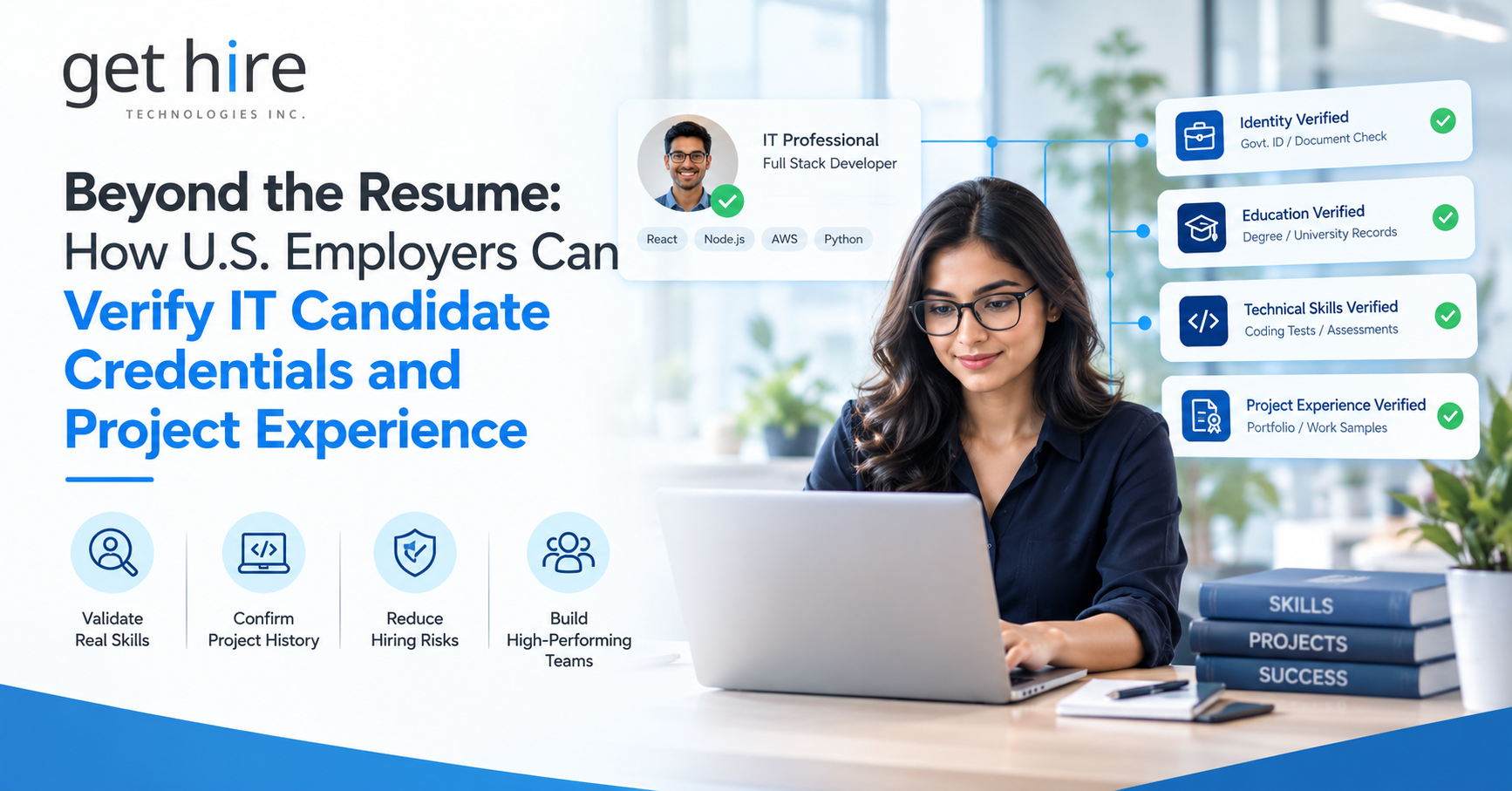


A resume is a great place to begin, but it’s not an indicator of whether an IT candidate can do the job. While technology workers can include well-known products, great titles, certifications and “successful” projects, job hiring committees are left to determine the specifics of the candidate’s role.
Employers are going beyond keywords in a competitive market. They are accrediting credentials, observing project evidence, posing relevant questions and applying structured assessments to make informed decisions. For employers, it lessens hiring risk and provides a level playing field for qualified job applicants to show their stuff.
Verify Credentials Directly
Find out first the requirements for the job. Check qualifications, certifications, licenses, work record, job title and training with the institution that awarded them, previous employer, licensing organization or approved verification provider. Independent verifications are more likely to be accurate than information provided by the candidate alone.
Not all certificates are created equal. One position might require a cybersecurity certification or cloud credential, while the other may be required for a professional license. Have a job-specific checklist to ensure consistency, relevance and adherence to the law when verifying.
In addition, the employer needs to be certain the individual conducting the interview is the same individual who will take the assessment, receive an offer, and start working. Regular identity verification is particularly crucial for out-of-the-office positions and those that access sensitive systems or have elevated privileges.
Explain the Candidate’s contribution
Project descriptions may make use of “we” rather than “I“. Natural, since technology work is collaborative, but employers want to know about the individual’s contribution.
Ask candidates to explain:
- What issue does the project address?
- What was their particular role?
- What technologies did they use exclusively?
- What were their compromises or restrictions?
- What criteria did they have to meet to succeed?
- If they were to improve, what would they do?
Good candidates have the ability to describe decisions, problems and outcomes in practical terms. They don’t have to divulge proprietary code or confidential information. They should be able to explain architecture, workflow, testing, security, collaboration and lessons learned, however.
Review Portfolios and Repositories
Portfolios, GitHub repositories, case studies, technical blogs, open-source contributions and project demonstrations can be helpful for appropriate roles. The materials demonstrate how a candidate deals with organization, documentation, testing, version control and problem-solving.
Look at and examine work critically. A public repository could be an old, collaborative, incomplete repository or it may not exist in connection with professional performance. Employers should question the candidate about the personal additions, improvements, modifications and oversight of their own work.
Project evidence is not meant to replace an interview and references. Using a single repository or a single coding test for hiring may bring about another sort of bias.
Use Job-Related Assessments
A practical should be similar to the work that the candidate will undertake. A developer could be debugging a little application, an engineer could be designing a service, a data professional could be cleaning and interpreting a dataset and a cybersecurity candidate could be analyzing a simulated incident.
Assessments must be realistic, time-bound and thoroughly explained. Don’t have extended extensions of homework, which looks now like real-life commercial work. Indicate to candidates whether they will have access to an external tool or artificial intelligence support and assess reasoning as well as the final answer.
The literature for technical interviews suggests that having multiple signals (such as live interview, coding exercise, design exercise, code review and behavioral discussion) is better than relying on one.
Facilitate Real-Time Technical Discussions
A live technical discussion reveals the way that candidates think, communicate and react to changes in the problem. Get them to walk through a previous project, read a sample design, describe a debugging method or describe the way they would deal with a failure.
The aim is not to make a daunting puzzle! To be able to grasp the person’s thinking. Provide candidates with an opportunity to ask clarifying questions. Watch for logical reasoning, sound judgment, inquisitiveness and communication of technical concepts to various audiences.
Make sure there is a standard rubric for your scoring to ensure that interviewers are not judging on chemistry, but on similar attributes. Structured processes are more equitable and easier to justify when hiring.
Check References Carefully
Questions need to be precise and to the point for reference checking to be most useful. Verify the candidate’s job, project scope, duties, trustworthiness, communication and teamwork. Inquire about what support the person had and what types of environments helped him or her to be successful.
Talk to references directly via verified contact information, if possible. For candidates who have had confidentiality restrictions in place, share examples of transferable behaviors and responsibilities; do not ask for protected information.
Be an Effective Technical Recruiter
Aside from the mere string-matching of keywords, top IT staffing firms in USA like Get Hire Technologies know that technical recruiting demands more. They assist employers in understanding the work experience and skills that transfer to the employment setting, validate qualifications and showcase the right candidate for the job.
While recruiting, IT companies in USA inquire whether they are specialists in your technology field, employ structured screening, conduct assessments and have references to offer. Top IT staffing companies in USA should clarify the difference between status quo and artificial qualifications.
Even the best IT staffing companies in USA take care of the candidate experience. They have early steps to verify explanations, are sensitive to personal data and allow the candidate to explain discrepancies.
Ensure Information and Consistency
The verification needs to be comprehensive yet non-intrusive. Only gather information that has a direct relationship with the job; keep that information secure and private; follow the background-check guidelines and keep a record of who is handling each step of the background-check process.
At Get Hire Technologies, we think that, when it comes to hiring, it takes a combination of evidence and human judgment. While a resume may get you in the door, the employer will make their decision based on the documented credentials, the projects they have demonstrated, the way they conducted their interviews and demonstrated reliability and the references they have.
The goal here isn’t to distrust all candidates! It is so that claims are fairly tested, skills are coupled with real work and qualified professionals have something more than mere words to offer.
Frequently Asked Questions (FAQs)
Why are employers looking to check IT candidate credentials other than their CVs?
A resume helps to add background information, but cannot always validate skills, project contributions, job history or certifications. Credential verification, hands-on evaluations, project discussions, and reference checks enable employers to make better hiring decisions.
What to do when IT candidates provide certificates from multiple providers?
Employers may confirm certification from the issuing organization, the certification body, the licensing authority or through an approved verification body. They should ensure the verification of the name of the certificate, the credential number, issue date, expiration date and if applicable, appropriateness to the job.
How to verify project experience for a candidate?
Interviewers should inquire about candidates’ precise duties, technologies they used, problems they encountered, choices they made, and outcomes they achieved. Extra supportive evidence can be provided in the form of portfolios, case studies, code repositories, technical demonstrations and structured project discussions.
Which Technical tests should be included in a recruitment process?
Assessments used to be useful should demonstrate real work; if they don’t do that, then it’s not really useful. This can be anything from debugging an application, designing a system, reviewing code, analyzing data, creating an automation workflow or responding to a simulated incident in cybersecurity. Evaluations should be reasonable, work-oriented and time-bound.
How can top IT staffing agencies in USA help verify candidates?
The best IT staffing agencies in USA can take care of credential checks, employment verification, technical screening, structured interviews, reference checks, as well as project evaluation. They assist the employer in seeing beyond the keywords on the resume and finding candidates who have proven or demonstrated skills in the areas of their resume that are relevant to the job.