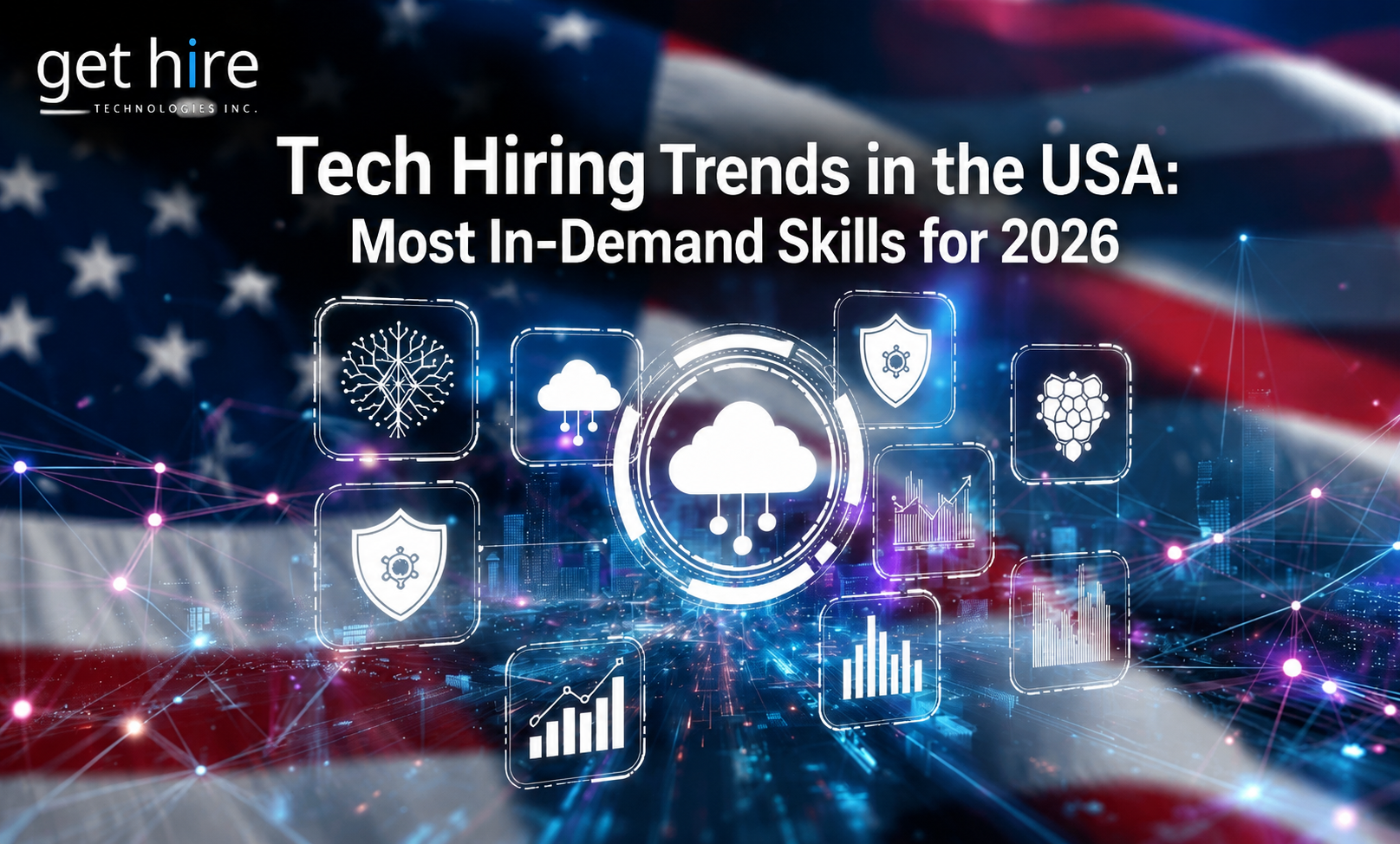

America’s tech labour market in 2026 is not like it was a year ago. Businesses continue to take employees on board, but with a degree of selectivity. The time of coding for ‘pure coding volume’ has passed. Employers are seeking individuals who can integrate AI into practical business applications, ensure the system’s security, and collaborate seamlessly with human colleagues and AI agents. Every day we at Get Hire Technologies, best staffing agency in USA, witness this transformation as we connect our talent to companies that do not have the luxury of skill shortages.
The state of Tech Hiring Today
Plans for hiring are still strong. Virtually all tech leaders project continued growth in the number of permanent employees and contract positions during the second half of 2026. However, the recruitment of the right personnel has been made more challenging. About 70% of employers say there is a shortage of qualified employees, particularly in areas such as AI, cybersecurity and cloud. It’s not budget that’s the constraint; it’s supply. Here, you’ll need the right skills to make you the best option.
“Being fluent in AI is no longer optional; it’s a prerequisite for success in the modern enterprise”.
Today, AI is featured in most tech job listings. A recent analysis found that 73–75 percent of tech jobs in the United States today call for a basic level of AI fluency, up a staggering 160 percent from just a couple of years ago. No longer are employers content with merely theoretical knowledge. They wish to acquire hands-on skills in the creation, implementation, management, and optimization of AI solutions.
Specific skills that are in high demand are generative AI, large language models, retrieval-augmented generation (RAG), agentic AI, prompt engineering and vector databases. The need for enterprise integration skills, which involve using AI agents with existing company systems, has increased by over 600 percent year over year. AI-related roles like AI/ML engineer, AI engineer and data engineer are some of the most sought-after positions. The professionals who can develop models and operationalize them at scale and know how to handle the risks of responsible AI are obvious.
Cloud, DevOps and Automation remain the backbone
Despite all the hype over AI, the underlying infrastructure is equally crucial. AWS, Docker, Kubernetes, Azure and Terraform are still very common in job postings. Hybrid and multi-cloud architects and platform engineers are always in demand. Companies develop faster with DevOps and DevSecOps skills such as continuous integration, automation workflows and infrastructure as code, while making their systems reliable.
These technical foundations complement the work with AI. Businesses require users with the ability to install models safely in the cloud, track them and automatically feed them data via pipelines. The professionals who are proficient with the cloud and AI are at the top of the line.
There is still a strong demand for cybersecurity. Cybersecurity demand continues to be robust.
The most difficult skill sets to fill are cybersecurity and artificial intelligence. The rise of artificial intelligence has broadened the attack surface, leading to the emergence of requirements for individuals knowledgeable in how to exploit the vulnerabilities of AI models, comprehend data privacy concerns, and apply AI-driven threat detection mechanisms. The importance of cloud security, DevSecOps skills, vulnerability assessment skills, and governance skills will not change. AI, or machine learning experience, is now listed as an explicit requirement in many security job postings.
The shortage of cybersecurity professionals is unlikely to abate with hundreds of thousands of unfilled positions in the United States. Individuals with a strong interest in AI and traditional security skills are highly paid and in-demand.
Programming Languages and Data Skills that remain relevant
Again, Python is the most popular programming language, closely followed by SQL, Java and JavaScript. These languages are the working languages of AI development, application, and data pipelines. Building scalable systems, maintaining data quality and assisting with business decisions are still in demand, as data engineering and analytics skills are valued. There are examples of many positions looking for tools like Databricks, Apache Kafka, and Power BI that can be seen frequently in the postings.
The growing importance of Human Skills
Interestingly, communication comes before AI in the list of top requested skills, with hundreds of thousands of job postings seeking it more often than AI itself. Collaboration, leadership, analytical thinking, adaptability and professionalism are next in line. Technology alone is not enough; employers know this. Teams require individuals who can communicate at a higher level, integrate the various functions and adjust quickly to changing tools and priorities.
The ability to check outputs, make judgments and maintain projects on course to business objectives is a real differentiator in an age of AI agents and quick automation.
The implications for job seekers and companies
The 2026 market values skill development with a laser-like intent as opposed to scattering it around in general. By dedicating time to learning AI concepts, cloud platforms, security basics, and core programming languages, candidates are well-prepared. Those technical abilities are enhanced by soft skills and the ability to learn continually.
Meanwhile, businesses have to wait longer for a skilled candidate to come to them and are also subjected to more competition. Many searching for quick fills as they develop in-house skills are using contract and temporary hiring services. As many look around to fill in holes quickly while developing in-house skills, they are turning to contract and temporary hiring solutions. This opens the door to professionals who embrace projects as paid opportunities and can evolve to longer-term employment.
How Get Hire Technologies Helps You Navigate the Market
We are attuned to these ever-changing requirements at Get Hire Technologies, best staffing agency in USA. Our experts monitor client demands in real time across the fields of AI, cybersecurity, cloud and software development. We demonstrate to candidates the exact skill sets that employers want and we link them up with job opportunities that candidates may not be able to find on public job boards. In business development, we uncover talent that already has the real-world experience needed to see results – without much ramp-up time.
Whether you are hiring an organization to fill important positions you can’t find, or a professional or employer looking to match your skills to what employers are seeking in 2026, the way forward is easier with partners that know both sides of the market.
The U.S. tech hiring market is more developed. The only thing that matters is speed, specialization, and an integration of technical and human skills with AI. People who abide by these developments will experience robust prospects. But those who wait will fall behind.
Contact Get Hire Technologies to get the right team or you in the right seats ahead of the 2026 hiring. We bring talent and businesses together through a marketplace that values the right skills at the right time.
Frequently Asked Questions (FAQs)
Which tech skills are most sought after in 2026 in the USA?
The top skill is AI fluency, which is the most frequently mentioned technology skill in job postings, appearing in 73–75% of them. Skills that are also in high demand are: Python, cloud (AWS and Azure), cybersecurity, DevOps/DevSecOps, data engineering, SQL and Kubernetes. Upon checking the discussion about the most important soft skills among employers, communication and adaptability are on the same level of importance.
Why is AI starting to play a vital role in nearly all tech careers in 2026?
As companies move beyond experimentation, professionals are required to integrate, operationalize, and govern AI systems in real business applications. AI skills such as generative AI, agentic AI, RAG, prompt engineering and enterprise integration have all exploded as companies integrate AI into their current infrastructure.
What are the toughest technology positions to fill at this time?
AI/ML engineers and cybersecurity engineers are currently the two toughest jobs to fill. There is also a high demand and low number of skilled candidates for data engineers, cloud architects and DevOps experts who have hands-on experience with AI.
For skills that are so specific, do soft skills still come into play?
Yes. Even though AI is not the most commonly mentioned skill listed in job postings, surpassing only by communication. The ability to work collaboratively, lead others, think analytically and be adaptable are what enable professionals to work with human teams and AI agents.
What are the ways a job seeker can make the top of their resume list stand out in the 2026 tech job market?
Prioritize using multi-competent skills clusters over individual skills. Combine AI proficiency with expertise in cloud, security or data engineering; have a solid grasp of the core programming languages, particularly Python, and have excellent communication skills. Collaborating with a staffing partner like Get Hire Technologies can also uncover hands-on opportunities that don’t show up anywhere else.
Is there still an industry that employs people in permanent roles or is it all about contracts now?
Both. Hiring more permanent workers, as well as hiring more contracts and temps to fill short-term skills shortages, are a few of the strategies many employers are looking to pursue. This dual strategy allows candidates the flexibility of opportunities in project positions, which can often become permanent.